
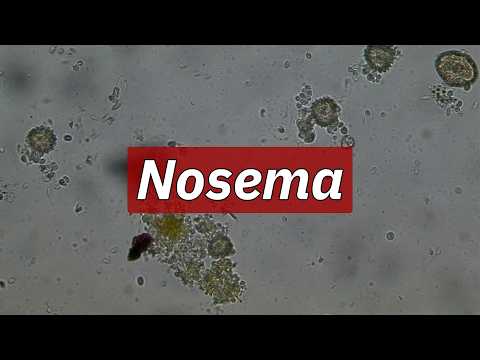
Nosemosis is a disease caused by fungal pathogens of honey bees. It can kill individual bees and weaken entire colonies. In this episode, Dr. Ellis discusses how to recognize signs of infection and outlines control measures for Nosema.
Links:
📲 Follow us on Instagram, Facebook and X @UFHoneyBeeLab
🎧 Listen to “Two Bees in a Podcast” on any podcasting app
📖 Interested in learning more?: https://tinyurl.com/entnemdept
📩 Please direct any inquiries to our email: honeybee@ifas.ufl.edu
📚 Visit our website for more resources: www.UFHoneyBee.com
Copyright Attribution (Listed in order of appearance):
– Intro & Outro Music: Credit to Zakhar Valaha, Pixabay.com
– Image of Nosema apis and Nosema ceranae spores: Image Credit to Aneta A Ptaszyńska, ResearchGate
– Image contains separate sections. In A: Light micrographs of spores of Nosema neumanni n. sp which seem slightly smaller than spores of Nosema ceranae (in B) and Nosema apis (in C). In D, E and F: electron micrographs of spores of Nosema neumanni n. sp. with electron dense exospore (Ex) and electron lucent endospore: Image Credit to https://doi.org/10.1016/j.ejop.2017.07.002
– Image of honey bee fecal matter on the front of a blue hive: Image Credit to Michael E. Wilson, beeinformed.org
– Image of honey bee midgut that is heavily infected: Image Credit to Brunella Restucci, ResearchGate
– Image of a Fumagilin-G container: Image Credit to mannlake
Tags:
#honeybees #honeybee #beekeeping #beekeeping101 #beekeeper #honeybeefacts #universityofflorida
