
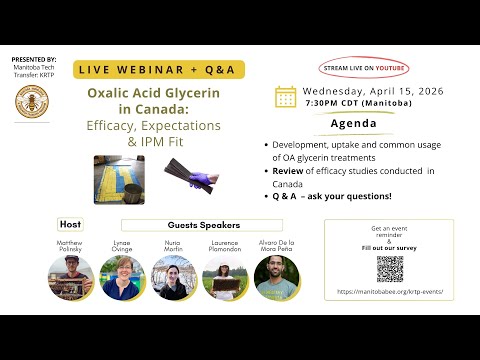
Description:
The session will feature four invited speakers with brief 10-minute talks, followed by a chat-based Q&A. Hosted by Matthew Polinsky from Manitoba Tech Transfer (KRTP), featuring Lynae Ovinge (AB), Nuria Morfin (MB), Alvaro De la Mora (SK) and Laurence Plamondon (QC). At the end of all presentations put all your remaining questions into the chat!
Bios:
Matthew Polinsky is the Program Lead for the Manitoba Knowledge and Research Transfer Program (KRTP). With 20 years of apiculture experience, his background is primarily in commercial beekeeping in Saskatchewan, New Zealand, and Australia, as well as urban beekeeping in Montreal. His recent and ongoing work with the KRTP centres on field-testing a range of methods and products aimed at improving bee health and colony performance, including; RNAi varroa biopesticides, oxalic-acid–glycerin strips, potential viral mitigation via a P. larvae vaccine, surveillance of miticide-resistance in varroa populations, and honey bee feed quality evaluations. As KRTP Program Lead, his role also includes extension services through hands-on field support and the development of educational materials and events.
Lynae Ovinge operates Buzzworthy Solutions where she provides contract/consulting services to the beekeeping and bee research community. She grew up on a mixed grain/cattle farm in southern Alberta and learned beekeeping on commercial honey farms. Lynae has a Master’s of Science from the University of Alberta and has spent many years studying honey bee health and canola pollination with Dr. Shelley Hoover in Lethbridge. Her experience also includes temporary roles as an apiary inspector, Alberta Provincial Apiculturist, and lead of the Alberta Beekeepers Tech Transfer Program.
Nuria Morfin is an Assistant Professor in Apiculture and Honey Bee Biology at the University of Manitoba with expertise in Integrated Pest Management (IPM), selective breeding, and honey bee pathology. She earned her Ph.D. at the University of Guelph and later served as the lead of the British Columbia Technology Transfer Program, where her focus was supporting the beekeeping industry through research and education. She has collaborated on numerous research projects across North America and has taught courses in IPM, queen rearing, and honey bee biology.
Laurence Plamondon is a Project manager at the Deschambault Animal Science Research Centre (CRSAD) in Quebec. She has worked on Varroa control, organic fall feeding, queen banking, blueberry pollination, and knowledge transfer to beekeepers. She is also a licensed agronomist with a Master’s degree focused on summer treatments against Varroa, and is currently pursuing a PhD within the ApiOmic project, focusing on the genotyping and genetic diversity of the honey bee superorganism.
Alvaro De la Mora is a postdoctoral fellow at the University of Saskatchewan’s Western College of Veterinary Medicine, bringing over a decade of honey bee research experience. He began studying Nosema ceranae at the University of Guelph’s Honey Bee Research Centre in 2011, where he later completed his PhD focusing on low Varroa growth as a key trait for mite-resistant honey bees. More recently, his work has focused on optimizing winter Varroa treatment windows across the Canadian Prairies, including oxalic acid applications through glycerin, dribble, and vaporization methods.
